Independence and trademark notice: cyberpowerups.ca is an independent technical publication. It is not affiliated with, endorsed by or sponsored by Cyber Power Systems. CyberPower and related product names are trademarks or property of their respective owners and are used nominatively to discuss public manufacturer evidence.
CyberPower publishes a short industrial case about a large agricultural processing company whose previous power solution left it unable to fulfil purchase orders during electrical events. CyberPower states that its engineers designed a scalable three-phase UPS system to support the company’s rapidly growing business needs [1]. The related current product page describes CyberPower’s online double-conversion modular UPS platform, built around 10 kVA and 10 kW power modules, with model-dependent growth from 10 to 20 kVA or 10 to 40 kVA and configurable redundancy [2].
The customer is anonymous in the manufacturer publication. The public material does not provide the plant location, process load, UPS model, installed capacity, module count, battery autonomy, redundancy state, event log, production output, purchase-order value, commissioning result or measured savings. This case therefore examines the design pattern and evidence needed to apply it. It does not claim a specific operational outcome beyond CyberPower’s published description of the problem and solution.
Business interruption and critical-load boundary
An agricultural processor can have office IT, order entry, enterprise applications, network and communications, laboratory systems, refrigeration controls, process automation, safety systems and production equipment. Not every load belongs on the same UPS. Large motors, heaters and drives may require different ride-through, generator or power-quality strategies than control and IT loads. The first design task is to identify which functions prevented order fulfilment and which electrical interruption actually caused the loss.
The critical-load schedule should record normal kW and kVA, peak or inrush, power factor, harmonics, voltage, phase, required ride-through and shutdown or restart behaviour. The consequence of interruption should be tied to an operating function. A server that stops accepting orders may need minutes of autonomy and orderly shutdown. A programmable controller may need continuity through generator start. A complete process line may be unsuitable for a small modular UPS and require a larger engineered system.
CyberPower’s publication uses the phrase “electrical events” without specifying outage, sag, surge, frequency variation, transient, internal fault or planned transfer [1]. A new project needs power-quality records and equipment logs so the solution addresses the actual event.

The UPS scope begins with the functions that stop order fulfilment, not with the total plant service or a vendor nameplate.
Why modular growth can fit a processing site
A modular UPS allows installed power modules to be added within the cabinet’s approved limit as load grows. CyberPower’s current product page describes 10 kW modules and model-dependent 20 kVA or 40 kVA frames, with N+1 capability on module configurations and parallel system capability for larger arrangements [2]. Those are current general platform claims, not confirmed details of the anonymous customer installation.
The design benefit is staged capacity. A site can install the power needed for the validated load plus a documented growth and redundancy allowance, then add modules when measured demand justifies them. This can avoid buying all future capacity on day one. The corresponding risk is false modularity: cabinet space, input and output conductors, bypass, battery, cooling, switchgear and room infrastructure must all support the future state.
Redundancy also needs arithmetic. If the load requires N modules, N+1 means one additional qualifying module remains available. The remaining installed modules must support the critical load after the specified module is removed. A module-level N+1 claim does not prove an independent bypass, battery, controller, output bus or upstream source.
Architecture options
The processor could protect individual controls with distributed single-phase UPS units, centralize selected loads on one fixed three-phase UPS, or use a scalable modular three-phase system. Distributed units are easy to deploy but create many batteries and inconsistent monitoring. A fixed central UPS simplifies operation but can force an early replacement when the load grows. Modular three-phase power supports staged capacity and serviceable modules, while requiring careful shared-path and future-state planning.

The modular approach is strongest when the critical load and future state are measured and the shared infrastructure is sized from the outset.
| Approach | Strength | Main exposure | Best evidence before selection |
|---|---|---|---|
| Distributed single-phase UPS | Fast local deployment and load isolation | Many batteries, inconsistent alarms and fragmented maintenance | Complete device inventory and coordinated shutdown plan |
| Fixed central three-phase UPS | One operating and monitoring platform | Capacity growth may require frame replacement | Stable load forecast and accepted single-frame states |
| Modular three-phase UPS | Staged growth and possible module reserve | Shared bypass, battery, controls and future infrastructure limits | Measured load, module arithmetic and full future-state one-line |
Canadian buyers comparing available systems can review the CyberPower UPS collection. Product pages are a procurement starting point, not a site design or confirmation of the anonymous case configuration.
Facilities requiring field service can use Canada-wide UPS services for load assessment, maintenance and commissioning. We did not perform the published CyberPower project.
Battery and recovery strategy
The public case does not state runtime or chemistry. A processing site must define what the UPS is expected to do: bridge generator start, allow an orderly stop, maintain controls through a short event, or support a longer business-continuity window. Each scenario creates a different autonomy and recharge requirement.
Battery sizing uses the validated critical kW, UPS efficiency, DC limits, exact discharge data, end voltage, temperature, aging and margin. Growth in power modules can outpace the original battery. The future-state plan should show whether autonomy falls as load grows, whether battery cabinets will be added and whether the charger can recover within the required time.
Industrial environments need special attention to temperature, dust, vibration, moisture, chemicals and access. The chosen UPS and battery enclosure must be suitable for the actual room or be placed in a controlled electrical space. A modular rack product should not be assumed suitable for a harsh process area without documented environmental ratings.
Integration and monitoring
The UPS needs coordination with utility sources, generators, automatic transfer equipment, bypass, distribution and the protected loads. The one-line should identify normal, bypass, battery and maintenance states. Protection and arc-flash studies must include the final battery and system fault contribution.
Monitoring should provide input and output values, load, module status, battery alarms, environmental data and event history. The current CyberPower product family supports management options, but the exact card, protocols and software must be selected and maintained for the installed model. Network interfaces require segmentation, supported secure protocols, unique credentials, synchronized time and clear remote-action authority.
Business continuity also needs an application response. The UPS can preserve power, but an order system, database or process controller may still require graceful shutdown, restart sequencing and communication checks. Commissioning should confirm both electrical response and application behaviour.
Commissioning and measurement
The site acceptance plan starts with nameplate, module, battery, conductor, protection, bypass and monitoring verification. Baseline measurements capture source, load, power factor, harmonics, temperature and battery condition. Approved tests then verify alarms, module removal or unavailability where permitted, bypass behaviour, battery operation, generator interaction and restoration.
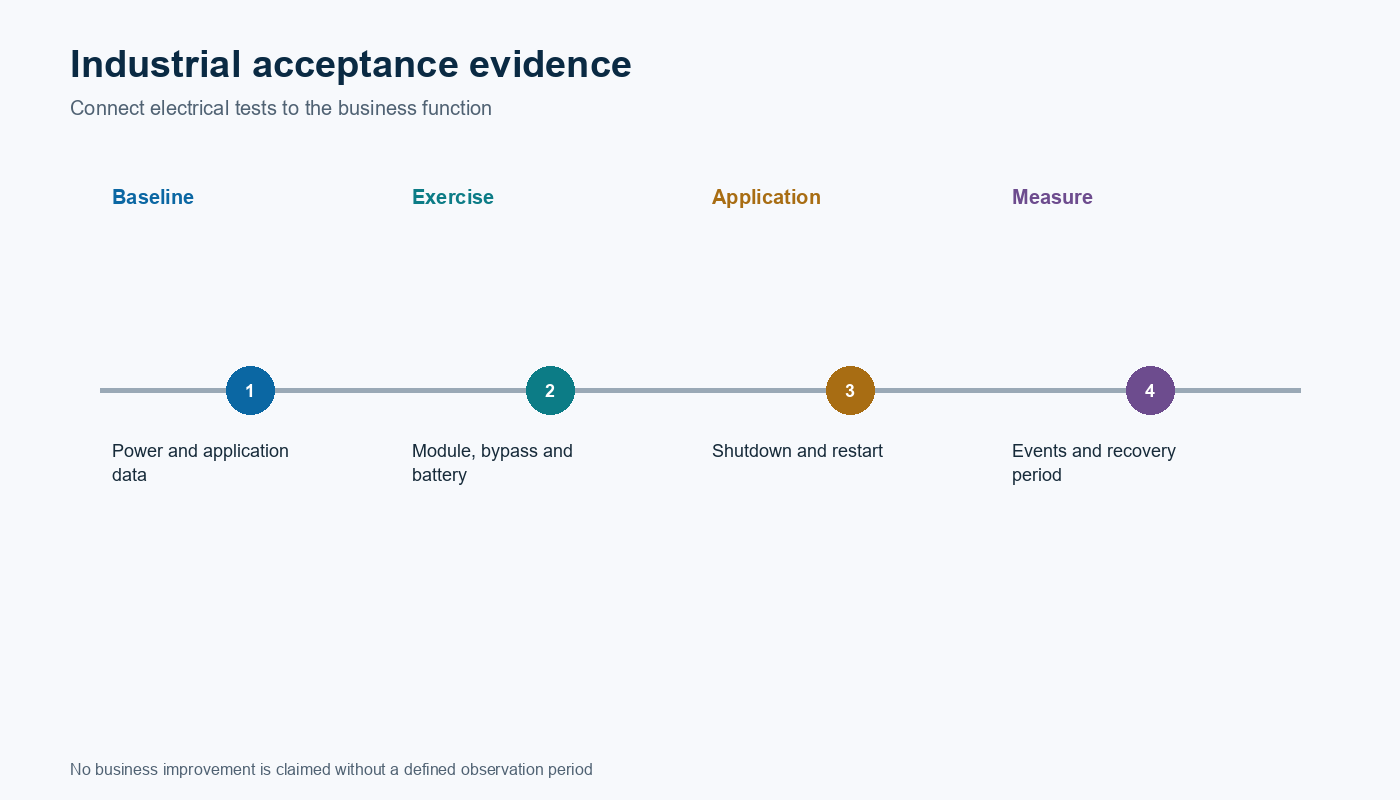
The acceptance record connects electrical performance to the order-processing or control function the UPS is intended to protect.
If the business case is reduced inability to fulfil orders, the measurement plan should define the relevant operational indicator. Examples include duration of electrical events, UPS-supported minutes, application availability, incomplete orders and recovery time. Commercial values and production data can remain confidential while the method and normalized results are documented. Without a baseline and observation period, savings or reliability improvements should not be claimed.
CyberPower-published result and limits
CyberPower states that its engineers designed a scalable three-phase UPS system for a large agricultural processing company with rapidly growing needs, after the previous solution left the company powerless to fulfil purchase orders during electrical events [1]. The current product page describes scalable online double-conversion modular systems and N+1-capable modules [2].
The public material does not report whether order fulfilment improved after installation, how many events occurred, what load was protected, which model was installed or how the system was tested. It also does not establish Canadian certification, availability or service coverage for the anonymous project. Those points must be verified for a Canadian deployment.
Lessons for industrial UPS design
- Define the business function and event that caused the interruption before selecting topology.
- Separate controls and IT from plant loads that need a different power strategy.
- Size the installed modules from measured demand, then show the arithmetic for reserve.
- Design the future input, bypass, output, battery, cooling and room capacity at the same time as the modular frame.
- State how autonomy and recharge change as modules and load are added.
- Commission application response as well as electrical operation.
- Measure operational outcomes over a defined period before claiming business improvement.
Information required before releasing a similar design
A similar processor needs power-quality logs, a critical-load schedule, operating consequences, generator and source data, required autonomy, growth cases, selected frame and module limits, redundancy states, bypass and battery design, environmental suitability, protection study, monitoring and cybersecurity plan, application shutdown and restart sequence, commissioning scripts and an outcome measurement method. A scalable product is useful when the whole system and the business process can scale with it.
Sources
- CyberPower, Powering Industrial Solutions: https://www.cyberpowersystems.com/resources/powering-industrial-solutions/
- CyberPower, 3-Phase Modular UPS Systems: https://www.cyberpowersystems.com/promotions/3-phase-modular-ups-systems/
- Internal knowledge library, Three-Phase and Data Center Power.
- Internal knowledge library, UPS Monitoring Cybersecurity and Network Integration.