A CyberPower Replacement Battery Cartridge is a preassembled sealed lead-acid battery pack, carrying an RB-series part number, that restores the stored-energy function of a CyberPower UPS whose internal batteries have gone weak or flat, without replacing the unit itself [1]. The pack is specific to the UPS model, and on most CyberPower units the battery is user-replaceable, so the practical questions are narrow: which cartridge is correct for a given model, what the alarm and the collapsed backup time are telling you, and whether buying a battery is even the right move [1] [2].
Independent service and trademark notice
cyberpowerups.ca is an independent UPS service provider, and is not owned, operated, sponsored, or endorsed by CyberPower Systems. CyberPower, PFC Sinewave, OR Series, Smart App Sinewave and Smart App Online, and related product-line marks, are trademarks of Cyber Power Systems, Inc., used here nominatively to identify the equipment discussed. The part numbers and specifications in this paper are taken from CyberPower’s own product pages on the access date and should be verified against the unit before purchase.
If your CyberPower UPS is beeping or the backup time has collapsed, start here
If a CyberPower UPS is beeping on battery, showing a battery or fault indicator, or holding only a fraction of its former runtime, work through five steps before buying anything:
- Recharge the unit fully, then run its self-test from the display or the front button. Read the battery verdict only after a full charge [7].
- Read the exact UPS model number and the serial-number prefix from the rating label, on the rear or the underside of the unit. Both can decide which cartridge is correct [3].
- Match the cartridge to the model using Figure 1 or CyberPower’s Battery Replacement Tool, then verify the pack’s stated voltage and amp-hour rating against the unit [1] [2].
- Fit the correct RB cartridge, and mind the hazard: a UPS battery stays energized even when the wall power is off, so keep metal tools and jewellery clear of the terminals and follow the manual. Where the specific model lists the battery as hot-swappable it can be changed with the unit running, but on a higher-voltage pack of roughly three or more batteries in series, treat a live swap as qualified-service work rather than a home task [3].
- If the alarm returns with a new, known-good cartridge, stop buying batteries. Suspect the charger or the electronics, or decide whether the unit itself has reached the end of its economic life.
The rest of the paper explains each step and the evidence behind it.
Who this paper is for and what it covers
The paper is written for home, small-office and rack users in Canada who own a CyberPower UPS and have to act on a beeping unit, a lost backup time or a battery quotation they cannot evaluate. CyberPower’s range runs from consumer and small-office towers up to rack and online units, and most of the units sold are consumer or SOHO models whose battery is front-accessible and customer-installable, which shapes the economics of every decision here [5].
The line dividing a disposable consumer unit from a serviceable business unit is topology and what the unit protects, not the badge or the physical size [5]. A retail tower guarding a home computer sits on one side; a small online unit guarding a server or a network closet sits on the other, even when the two are the same height. The cross-reference and the decisions below apply to single-phase CyberPower equipment. Values that come from CyberPower’s product pages are cited as such, and values that are general engineering guidance are labelled that way.
The decision behind a CyberPower battery search
Most CyberPower battery searches hide the same short question: the unit is complaining, or the batteries are past some age, so what exactly should be bought, and is buying a battery the right decision at all?
That question breaks into four smaller ones, and the paper takes them in order. First, what is a Replacement Battery Cartridge and how is the correct one identified for a specific model? Second, what do the beep, the self-test and the collapsed runtime tell you about the machine? Third, how fast do these sealed lead-acid batteries really age in a Canadian home or closet? Fourth, when does the evidence point away from a cartridge, toward replacing the unit or moving up to a serviceable platform?
Terms, boundary and assumptions
A UPS carries its connected load through utility outages and disturbances using stored energy. In these CyberPower ranges that energy sits in sealed valve-regulated lead-acid (VRLA) batteries packaged as a cartridge. The system boundary of the paper is the UPS and its battery cartridge: upstream building power and downstream load appear only where they change a battery decision.
Three assumptions apply throughout. The equipment is a single-phase CyberPower unit installed in Canada. No site-specific measurement is available to the paper, so no runtime figure is claimed for any load; CyberPower’s published values and labelled general guidance carry the analysis instead. Finally, the reader can read the exact model number and serial prefix from the unit’s rating label, which every identification step depends on.
Topology differs by line, and it decides how the battery is used [3]. The PFC Sinewave (CP) towers, the OR Series and the Smart App Sinewave (PR) units are line-interactive, which means they run the load from utility power, regulate voltage, and switch to the battery inverter only when the power fails. The Smart App Online (OL) units are online double-conversion, which means they run the load continuously through the inverter so the transfer to battery is seamless. PFC Sinewave and Smart App Sinewave are CyberPower’s names for lines that deliver a true sine-wave output on battery, which suits the active power-factor-corrected supplies in modern computers.
What a CyberPower replacement battery cartridge is
CyberPower assigns each supported UPS a Replacement Battery Cartridge, identified by an RB-series part number. The cartridge is not a bare cell: it is a preassembled sealed lead-acid pack, built for easy installation, that restores a UPS whose internal batteries have become weak or completely depleted [1]. CyberPower states the way to find the correct one plainly: read the Specifications section of the UPS User Manual, or open the Specifications tab of the model’s web page, or use the Battery Replacement Tool that maps a model to its cartridge [1] [2].
Two facts sit behind that tidy definition. Identification starts from the UPS model, not from the label on the old battery, because the model determines the pack. And the pack itself is a specific configuration of a stated number of batteries at a stated voltage and amp-hour rating, so the reader is matching a whole assembly, not a chemistry. The next section turns that into a table.
Model-to-cartridge cross-reference
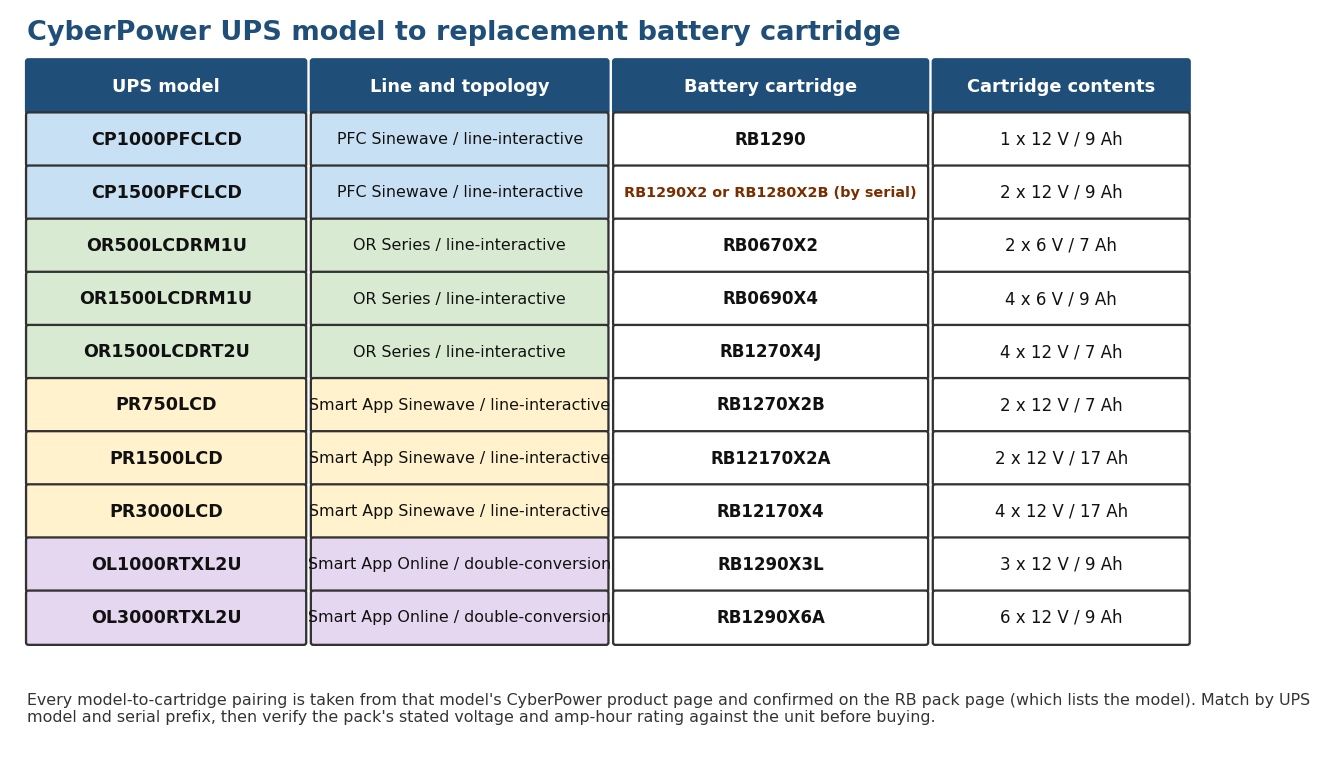
Figure 1 maps ten representative CyberPower units across the four lines to their cartridges, with the pack contents beside each one. Every pairing is taken from that model’s CyberPower product page and confirmed on the RB pack page, which lists the model among its compatible products; the one-to-one sources for each model and each pack are recorded in the source ledger kept with this document [3] [4].
The same cross-reference as text, for readers using assistive technology:
| UPS model | Line and topology | Replacement battery cartridge | Cartridge contents (as specified) |
|---|---|---|---|
| CP1000PFCLCD | PFC Sinewave, line-interactive | RB1290 | 1 battery, 12 V / 9 Ah |
| CP1500PFCLCD | PFC Sinewave, line-interactive | RB1290X2 or RB1280X2B (by serial) | 2 batteries, 12 V / 9 Ah |
| OR500LCDRM1U | OR Series, line-interactive | RB0670X2 | 2 batteries, 6 V / 7 Ah |
| OR1500LCDRM1U | OR Series, line-interactive | RB0690X4 | 4 batteries, 6 V / 9 Ah |
| OR1500LCDRT2U | OR Series, line-interactive | RB1270X4J | 4 batteries, 12 V / 7 Ah |
| PR750LCD | Smart App Sinewave, line-interactive | RB1270X2B | 2 batteries, 12 V / 7 Ah |
| PR1500LCD | Smart App Sinewave, line-interactive | RB12170X2A | 2 batteries, 12 V / 17 Ah |
| PR3000LCD | Smart App Sinewave, line-interactive | RB12170X4 | 4 batteries, 12 V / 17 Ah |
| OL1000RTXL2U | Smart App Online, double-conversion | RB1290X3L | 3 batteries, 12 V / 9 Ah |
| OL3000RTXL2U | Smart App Online, double-conversion | RB1290X6A | 6 batteries, 12 V / 9 Ah |
Three patterns are worth naming. The consumer PFC Sinewave towers take a small pack, one 12 V / 9 Ah battery on the CP1000PFCLCD and two on the CP1500PFCLCD [3] [4]. The rack and tower OR and PR units step up in string count and capacity, from the two 6 V / 7 Ah batteries in the OR500LCDRM1U cartridge to the four 12 V / 17 Ah batteries in the PR3000LCD cartridge [4]. The online OL units carry the largest strings, three 12 V / 9 Ah batteries on the OL1000RTXL2U and six on the OL3000RTXL2U, because double-conversion holds the battery on a higher DC bus [3] [4]. The batteries in a pack are wired to form the unit’s DC bus; where the pack is a simple series string, a two-battery 12 V pack gives a nominal 24 V and a six-battery pack up to a nominal 72 V, though the exact series or parallel arrangement is set by the unit’s design and should be read from the manual rather than assumed.
How to read an RB part number, and why you still check the spec
The RB part number looks like a specification, and it partly is. Reading RB1290X2 left to right, RB marks a replacement battery, 12 is the nominal cell voltage, 90 is the nominal 9 Ah capacity, and X2 is the number of batteries in the pack; a trailing letter, when present, marks a revision [4]. Figure 2 lays that out.
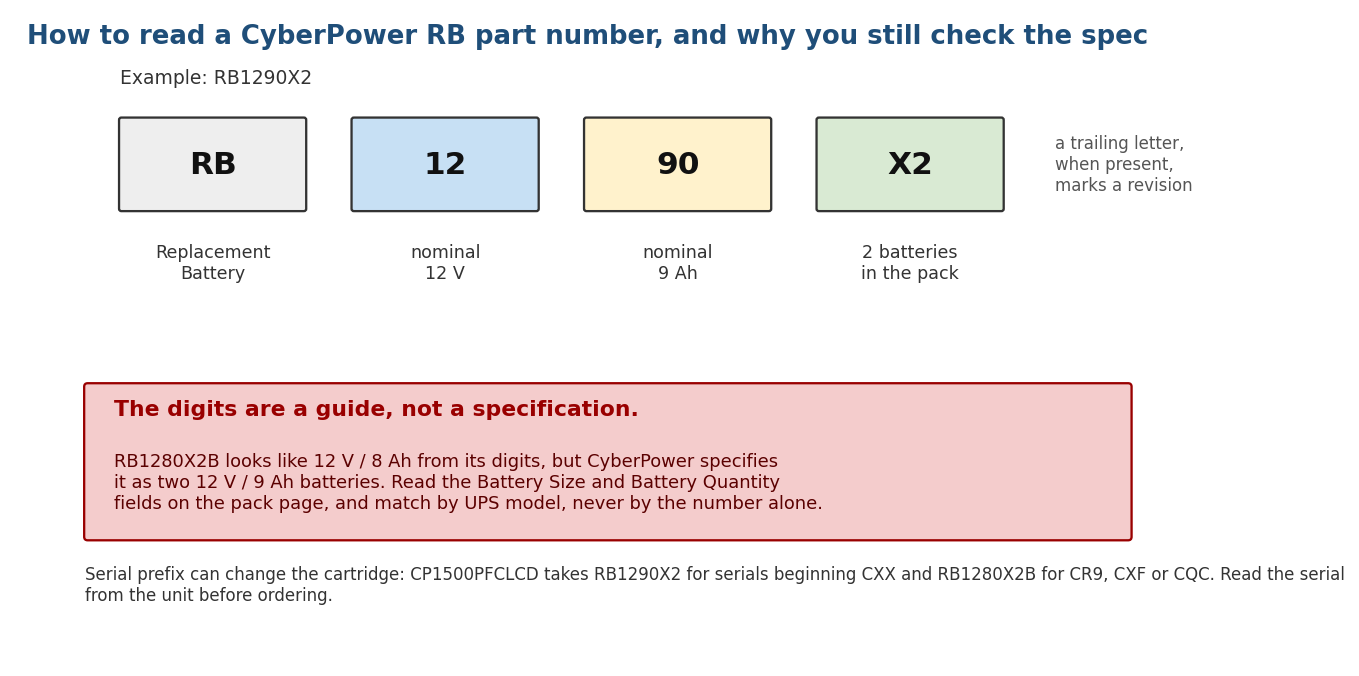
The caution matters because the digits are not a reliable decoder. RB1280X2B reads as 12 V / 8 Ah from its number, yet CyberPower specifies it as two 12 V / 9 Ah batteries on its own pack page [4]. A buyer who trusts the digits over the published Battery Size field can order the wrong pack. The safe rule is the one CyberPower uses itself: match by UPS model, then read the pack’s stated Battery Size and Battery Quantity, and verify them against the unit [1] [4].
The serial-number prefix adds a second check on some models. The CP1500PFCLCD takes RB1290X2 for serial numbers beginning with CXX and RB1280X2B for serial numbers beginning with CR9, CXF or CQC; the CP1350PFCLCD takes RB1270X2C for serials beginning with CXY and RB1270X2A for serials beginning with CQB or CR8 [3]. Two units of the same model number can therefore need different cartridges. Read the serial prefix from the rating label before ordering, and treat the model number alone as a starting point, not a purchase specification.
Reading the signals: beeping, self-test and collapsed runtime
A CyberPower UPS reports a weak battery through its alarm and its display: a beep pattern on battery, a battery or fault indicator, or a backup time on the LCD that has fallen well below the unit’s former figure. The model manual governs the exact beep and indicator meanings, so a specific pattern is confirmed there before acting on it [7].

The self-test is the honest starting point, with one limit. A short self-test can catch a disconnected or clearly weak battery, but passing one does not prove the unit will deliver its rated runtime; runtime proof needs a documented discharge, which is a separate exercise [7] [10]. A battery that has just failed to carry the load through an outage has given the strongest signal of all: the string can no longer do its job. Two further readings are useful. A runtime that has quietly halved points at aging cells even before an alarm. And an alarm that persists after a known-good cartridge is fitted is no longer a battery message; the suspect is the charger or the measurement path inside the unit [8].
How long CyberPower batteries last, and what shortens it
CyberPower does not publish a service-life-in-years figure for these batteries. Its published battery figure is the warranty: replacement batteries carry an 18-month warranty, and the UPS units themselves carry a 3-year warranty on the units reviewed here [1] [3]. Life in service is longer than the warranty on a cool, lightly cycled unit and shorter on a hot one, so a warranty term is a floor for planning, not the expected life.
As general VRLA guidance, sealed lead-acid UPS batteries run roughly 3 to 5 years at a 25 degrees Celsius reference, and a widely used engineering rule of thumb holds that service life roughly halves for every 10 degrees Celsius of sustained operation above that reference [6]. Applied to the band, a cabinet that sits at 35 degrees turns a 3 to 5 year battery into roughly a 1.5 to 2.5 year battery, and a 45 degree enclosure into roughly a 0.75 to 1.25 year battery. Figure 4 shows that arithmetic.

The chart is a teaching illustration, not a measurement, and the real derating curve of a specific cell governs any actual schedule [6]. The point for a Canadian owner is direction, not decimals. A closet or a media cabinet that runs warm through summer consumes batteries faster than its owner expects, and the first sign is often a failed self-test rather than a calendar reminder. A battery past its band with no test evidence is protection that can no longer be demonstrated, only assumed [7].
How to identify the correct cartridge for your unit
Identification starts from the model and the serial, feeds three checks that agree when done correctly, and ends with a physical verification. First, read the exact model number and serial prefix from the rating label on the rear or underside of the unit. Second, map the model to its cartridge through Figure 1 or CyberPower’s Battery Replacement Tool [2]. Third, open the cartridge page and confirm it lists your model among its compatible products, which closes the loop from the other side [4].
The physical check is not optional. Before installation, confirm the cartridge voltage, amp-hour rating, battery count and connector against the unit, so a number-only match cannot slip through a serial-variant or a revision change [1] [4]. When the model and cartridge are confirmed, CyberPower replacement batteries from a Canadian supplier keep the spent pack close to a domestic recycling stream and avoid cross-border battery freight.
A battery quotation is ready to compare on price only once it can state four things: the exact cartridge identity matched to your model and serial, the pack voltage and amp-hour rating, whether the cells are genuine CyberPower or clearly labelled compatible, and the warranty term on the pack. A quote that cannot name the model-matched cartridge and its rating is not yet ready to compare.
Genuine, compatible, and the safety-listing question
The Canadian market offers genuine CyberPower cartridges and a field of compatible assemblies. The engineering frame for that choice is narrower than the marketing around it. UL’s guidance on UPS battery retrofits is the anchor, and it is public: a UPS battery may be replaced only with the battery types identified on the equipment and in its instructions, and substituting a different type is an equipment modification whose continued safety listing is not established without further evaluation [9]. A compatible cartridge that matches the identified type, voltage, capacity and construction sits inside that boundary; a substitution that changes the type does not.
The practical rule for an owner follows in plain terms: replacing like with like is a maintenance task, while changing the battery type is a modification. Recognized industry practice, set out in the IEEE 1188 standard for stationary batteries, treats replacement as a maintenance decision based on test evidence rather than brand preference; the standard itself is a paid document, so the takeaway an owner can act on is to match the identified type and confirm the new pack tests good, not to buy on the label alone [10]. Where a listing or instruction calls for a flame-retardant case, UL 94 V-0 is the strongest of the commonly specified vertical self-extinguishing classifications for enclosure plastics, excluding the less commonly specified 5VA and 5VB classes, though UL 94 is a material-level test that does not by itself establish whole-product fire performance [11]. A replacement that quietly downgrades the case class changes something the original safety evaluation may have relied on.
One commercial point follows. Fitting a battery that is not the identified type can affect the equipment’s safety listing and the manufacturer’s warranty or support position, so where a unit is still inside its warranty, the battery-source terms are worth confirming before a non-genuine cartridge goes in [9] [3]. Converting a sealed-lead-acid unit to lithium is an engineering change, not a battery swap, because the charger profile and protection assumptions differ; it belongs on a platform designed for lithium or a formally evaluated system, not on a like-for-like cartridge order [6] [9].
Replace the battery, or replace the unit?
The cartridge is the right answer more often than not, and on a healthy CyberPower unit it usually is. A unit with sound electronics and only an aged battery takes the model-matched pack and returns to service for another battery lifetime, and because the battery is user-replaceable the owner can do it without a service call [1] [5]. Figure 5 pairs the recurring conditions with their default decisions for home, SOHO and rack users.

The same decision matrix as text:
| Observed condition | Default decision |
|---|---|
| Healthy unit, aged battery | Fit the model-matched RB cartridge (user-installable). Another battery lifetime. |
| Alarm persists after a known-good pack | Charger or electronics fault. On a consumer unit, replace it; board repair rarely pays. |
| Model discontinued, support or parts ending | Plan a replacement to a current platform while the cartridge is still stocked. |
| Load has outgrown a consumer standby or line-interactive unit | Step up to a serviceable online double-conversion platform sized to the load. |
| Warm cabinet or frequent outages consume batteries early | Fix the environment; shorten the replacement interval knowingly, not by surprise [6]. |
The unit itself becomes the better replacement in three situations. When the electronics are faulty, an alarm persists after a known-good pack, or the enclosure is damaged, board-level repair on a small consumer unit rarely pays against the cost of a current model, so replacement is the honest call [5]. When the model is discontinued and support or parts are ending, a planned replacement while the cartridge is still stocked beats waiting for a forced one; the PR750LCD, for one, appears as discontinued on its cartridge page even though the pack is still listed [4]. And when the protected load has outgrown a consumer standby or line-interactive tower, for example a home lab that has become a small server, the answer is a step up to a serviceable online platform sized to the load rather than another cartridge in an undersized unit [5].
For readers who would rather have the battery identified, supplied and installed, or whose unit needs assessment beyond a cartridge swap, a Canada-wide UPS battery replacement service covers identification, supply and installation. The self-serve path stays the one this section describes: read the model and serial, run the test, and decide from the evidence.
Field patterns from service work
One anonymized pattern from field service history fits a single-unit home or small-office owner directly. It is a recurring practice pattern, not a measurement from any named site [8].
The pattern is diagnostic order on aged units. When an old UPS reports an error, the first question is when the batteries were last replaced, because on an aged unit the battery is the most probable cause and the cheapest hypothesis to test [8]. Ruling the battery in or out before condemning the electronics prevents both a premature unit replacement and a pointless battery purchase on a unit with a real internal fault. For an owner, that is the same order the fast path above uses: recharge and self-test first, identify and replace the cartridge second, and suspect the electronics only when a known-good pack does not clear the alarm.
Replacing the cartridge properly
Which CyberPower models allow a live change depends on the specific model. The OR500LCDRM1U, OR1500LCDRM1U and the PR models here list the battery as hot-swappable, so their pack can be changed with the unit running; the consumer PFC Sinewave towers list Hot Swappable as No, and the OR1500LCDRT2U and the online OL1000RTXL2U and OL3000RTXL2U pages state only that the battery is user-replaceable, so confirm hot-swap capability in the model’s manual before a live swap [3]. On a higher-voltage pack, roughly three or more 12 V batteries in series and up to a nominal 72 V on a six-battery pack, a live swap is qualified-service work rather than a home task, because the string voltage rises past the level generally treated as an electrical hazard.
Even where the mechanical swap is simple, four boundaries separate a proper replacement from a parts swap. Confirm before ordering: the model-and-serial identification and the physical verification described above happen before purchase, not at the rack. Respect the stored energy: a UPS battery does not de-energize when the wall power is off, so keep metal tools and jewellery clear of the terminals, follow the manual’s procedure, and treat any swollen, hot or leaking cartridge as a handling hazard rather than a routine part. Verify after installation by allowing the published recharge time, running the self-test and confirming the battery indication has cleared, then record the installation date so the next age-band decision has an anchor [7].
Close the loop on the old cartridge. A spent sealed lead-acid pack belongs in a battery recycling stream, not the trash, and lead-acid is among the most recycled battery types. In Canada, stewardship programs such as Call2Recycle operate a national drop-off network under provincial and territorial regulation, and buying the pack from a Canadian supplier keeps the old cartridge close to that domestic stream [12].
Failure modes, limitations and safety boundaries
The failure modes behind these decision rules are the ordinary ones for VRLA in float service: gradual capacity loss with age and heat, rising internal resistance, and occasional early failures that a self-test catches. A cartridge can also fail in a way that mimics something else, which is why the persistent-alarm rule earns its place in Figure 3: after a known-good pack, the charger path is the suspect, not the cells [8].
The limits of the paper are stated rather than implied. It publishes no runtime figure for any unit, because runtime depends on load, battery condition, temperature and configuration, and no discharge evidence is part of the document. The part numbers and pack specifications in Figure 1 are those CyberPower published on the access date, and a catalogue revision or a serial-prefix change can move them, which is why the physical verification step is mandatory. The battery-life bands in Figure 4 are general VRLA guidance and a derived illustration, not a CyberPower-published or measured figure.
The safety boundary is plain. Cartridge replacement per the manual is an owner task on models built for it. Anything beyond that, such as internal repair, a persistent fault, a live change on a higher-voltage string, or any work where the battery isolation state is uncertain, belongs with qualified service personnel. A unit that will not clear its battery indication after a known-good pack is telling you the problem is no longer the battery.
Decision rules and checklist
The paper reduces to six rules.
- Identify by model and serial, never by the RB number’s digits. Read the pack’s stated Battery Size and Battery Quantity, and verify voltage, capacity, count and connector against the unit before installation [1] [4].
- Recharge fully, then self-test, and only then read the battery indication as a verdict. A passed self-test is not a runtime proof [7].
- Plan replacement in age bands: roughly 3 to 5 years of general VRLA life, compressed by heat, against an 18-month battery warranty as the floor [1] [6].
- A persistent alarm after a known-good cartridge is a unit problem. Stop buying batteries and look at the charger or the electronics [8].
- Replace the unit, not the battery, when the electronics are faulty, the model is discontinued and parts are ending, or the load has outgrown a consumer platform [5].
- Treat a chemistry or case-class change as an engineering change with listing consequences, not a shopping option [9] [11].
For a household or a small office with more than one unit, add one habit: write down every battery installation date and every self-test failure somewhere a person will read them, because the cheapest battery decision is the one made on schedule rather than during an outage.
Sources
The material statements in this paper are bound to a source ledger and a claims ledger kept with the document, and every model and cartridge in Figure 1 has its own dedicated source entry there. The numbered sources are:
- CyberPower Systems, UPS Systems and User-Replaceable Batteries (feature focus). https://www.cyberpowersystems.com/feature_focus/ups-systems-and-user-replaceable-batteries-2/
- CyberPower Systems, UPS Replacement Batteries and Battery Replacement Tool. https://www.cyberpowersystems.com/products/ups/replacement-batteries/
- CyberPower Systems, UPS model specification pages for the units in Figure 1 (CP1000PFCLCD, CP1500PFCLCD, OR500LCDRM1U, OR1500LCDRM1U, OR1500LCDRT2U, PR750LCD, PR1500LCD, PR3000LCD, OL1000RTXL2U, OL3000RTXL2U), base path https://www.cyberpowersystems.com/product/ups/
- CyberPower Systems, replacement-battery pack pages for the cartridges in Figure 1 (RB1290, RB1290X2, RB1280X2B, RB0670X2, RB0690X4, RB1270X4J, RB1270X2B, RB12170X2A, RB12170X4, RB1290X3L, RB1290X6A), base path https://www.cyberpowersystems.com/product/ups/replacement-batteries/
- our service network, CyberPower and Consumer UPS: Context and Scope Note (internal engineering reference).
- our service network, UPS Replacement Battery Varieties for Technical Selection and Retrofit Safety (internal engineering reference).
- our service network, UPS Battery Testing and Condition Assessment (internal engineering reference).
- our service network, anonymized field case library, Engineering and Quoting Patterns (internal engineering reference).
- UL Solutions, Uninterruptible Power Supply (UPS) System, Retrofitting or Replacing with New Batteries. https://www.ul.com/news/uninterruptible-power-supply-ups-system-retrofittingreplacing-new-batteries
- IEEE 1188, Recommended Practice for Maintenance, Testing, and Replacement of Valve-Regulated Lead-Acid (VRLA) Batteries for Stationary Applications. https://standards.ieee.org/ieee/1188/11656/
- UL Solutions, Combustion (Fire) Tests for Plastics (UL 94 flammability classifications). https://www.ul.com/services/combustion-fire-tests-plastics
- Call2Recycle Canada, battery recycling programs. https://call2recycle.ca/what-can-i-recycle/